
MS-Tools started as our internal tool, built for our own work. Today it is also available by subscription, on request, and the plans are on the MS-Tools page. It is the tool we work with, and it monitors 22 client websites every day, the ones on a maintenance plan.
So why an article, and not just a page of plans? Because what a tool actually does says more about how a company works than any marketing line ever will. Words are roomy. A cron job, an automatic task on the server that wakes up every five minutes, is not. A cron job cannot tell you how serious we are; it either runs or it does not.
Let us start with three problems, and I have lived all three
Anyone who maintains other people’s websites runs into the same three, over and over. I did not read about them somewhere. I collected them the hard way.
You cannot see. You do not know a site went down until the client phones you. You do not know a certificate is expiring until the red warning appears in every visitor’s browser. And from that moment on you are not doing maintenance any more. You are doing firefighting. With everything that implies for your mood, for your day, and for a client’s trust, which takes months to build and cracks in a single phone call.
You cannot show your work. The client asks “what exactly do you do for me every month?”, which is a completely fair question, and the answer is verbal. There is no measurable history, only impressions. And impressions fade a lot faster than an invoice does.
You run out of time. Checking one site by hand, speed, SEO, SSL, broken links, WordPress, is half an hour of work. Times 22 sites, every month, that is eleven hours nobody has. Am I wrong? And please do not tell me you will find them at the weekend, because we both know how that story ends.
MS-Tools turns all three into automation. Not because automation sounds good in a brochure, but because a machine does not get tired, does not forget, and does not take August off.
Eight checks on every scan, and a ninth that steals the show
Each scan runs eight independent checks and keeps a full history, so that there is a comparison rather than a snapshot. The difference is the whole point: a photograph tells you how the site is today. A history tells you where it is heading:
- Performance on mobile and desktop, together with SEO, accessibility and best practices.
- SEO and content: titles, meta, heading structure, structured data.
- Infrastructure files: robots.txt, sitemap, llms.txt.
- SSL: days until the certificate expires.
- Technologies: what the site is built with and which add-ons it loads.
- WordPress audit for WordPress installations.
- Broken links.
- Environmental footprint of the hosting.
And a ninth that stands apart, because this is exactly where the misunderstandings start: real traffic. Unique visitors per month, bots excluded. No sampling, no third-party estimate. The gap between this and what an ordinary analytics tool shows, once you see it, tends to stay with you. And I do not mean for ten minutes.
Out of all this comes a health score per site, graded A+ to F on a 0 to 100 scale, a security score, and per-site SLA targets (the limits of our written commitment to the client) that light up the moment a metric falls outside them. A grade is not decoration. It is the thing you glance at and instantly know whether somebody needs to get out of their chair.
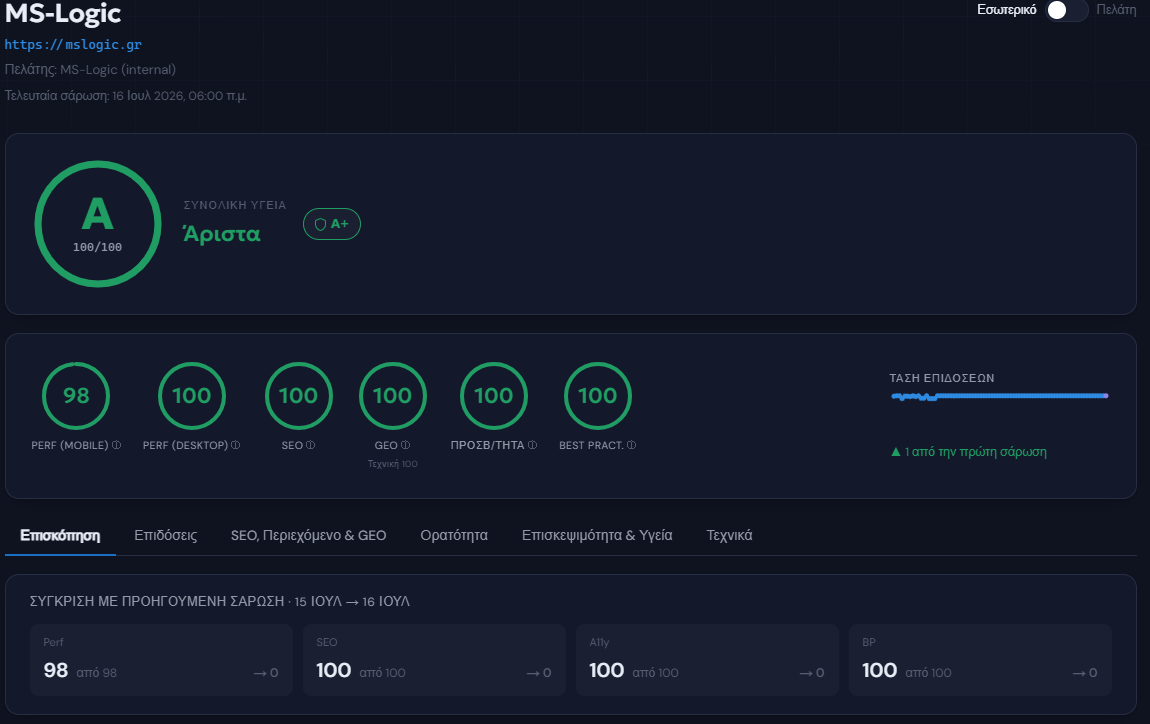
The watchman who never sleeps
Uptime monitoring runs every 5 minutes. Nothing remarkable so far, plenty of people do that. The details are what matter, as usual.
No false alarms. A momentary network hiccup does not fire an alarm, because an alarm that cries wolf stops being read. Like the car alarm down the street: the first time you worry, the fifth time you roll over and go back to sleep.
Two channels, with escalation. Email and Telegram, immediately. If the site stays down, the alert comes back, so the problem does not get lost in the flow of the day.
And now the point that decides whether any of the above is worth anything, because up to here it is architecture on a slide, and slides will tolerate absolutely anything: we tested it. We took sites down deliberately, in controlled tests, to see whether and how fast the alert arrives. It arrived on Telegram immediately. A monitoring system nobody has ever tested is not a system, it is a wish.
The SSL expiry warning fires when a certificate drops below 14 days. It has already fired several times, always in time. It is the kind of problem the client never sees, precisely because somebody saw it first. And yes, our best work is often the work nobody ever notices. Thankless, but there it is.
The part no conventional tool had
When SEO started turning into GEO, meaning getting recommended by answer engines (AI), we went looking for a tool that measures whether a brand appears inside their answers. We looked properly, let me be clear about that. There was none. So we built one. That is simply how I am wired: when I cannot find the tool, I open the editor.
The GEO panel in MS-Tools answers one question, one only: when a prospect asks an answer engine, do you show up?
MS-Tools asks real questions of Perplexity Sonar, GPT, Claude and Gemini. For each question we record whether the brand was mentioned, whether it was cited as a source, in what position, and with what share of voice against competitors. One click shows the full answer, with brand mentions highlighted and the sources as links.
The GEO score weighs mostly whether you appear in the answers, and less whether the site is technically ready. Because technical readiness is a precondition, not a result. Owning the running shoes is not the same as having run.
The check runs automatically every week for the sites that have the service, and keeps a history of every run.
And the other side: who is reading you
Prompt-testing, the test questions we run, answers “what do the engines say about you”. That leaves the other half, which is every bit as interesting: who visits your site, and what did they come for. We do not guess this, we measure it.
MS-Tools separates crawlers by purpose: some read in order to cite you, others harvest text to train models.
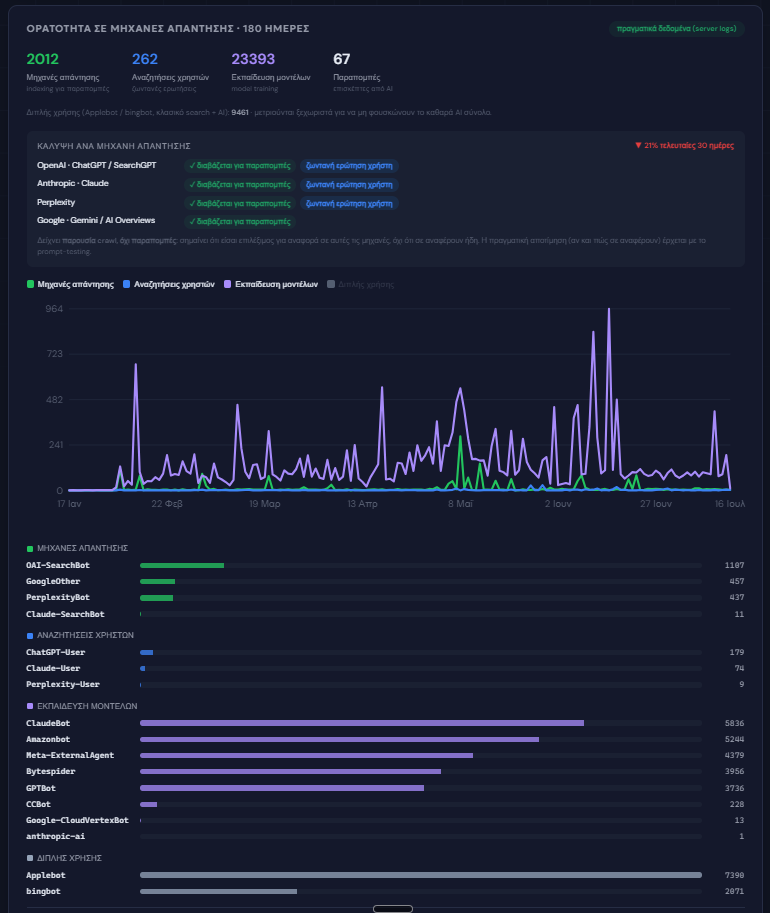
Here is what 180 days on a client website showed:
- 23,393 model training crawls. ClaudeBot leads with 5,836, followed by Amazonbot, Meta-ExternalAgent, Bytespider and GPTBot.
- 2,012 crawls from answer engines, meaning crawlers that read in order to cite. Mostly OAI-SearchBot, GoogleOther and PerplexityBot.
- 262 live user queries: somebody asked, and the model came to read the page right then.
- 67 referrals. Visitors who actually arrived from an answer engine.
- 9,461 from crawlers that do both, counted separately so they do not inflate the totals.
Sit with that ratio for a second, it is worth the time: for every single visitor an answer engine sent, 349 crawls went to model training. Your content is read a great deal and returns little. That is the new economics of search, in numbers rather than opinions. Suspecting it is one thing. Seeing it in black and white is another.
The panel also shows which engines read you at all: OpenAI, Anthropic, Perplexity and Google all pass through this site, and the first three also with live user queries.
And one clarification the tool itself makes, because this is exactly where the mistakes happen, usually stated with great confidence: crawl presence is not a citation. Being read means you are eligible, not that you are mentioned. Whether and how you are mentioned is answered only by prompt-testing. A tool that told you “ChatGPT reads you, therefore you appear” would be lying to you. With beautiful charts, but lying.
GEO, in other words, is not a theory we write articles about. It is a measurement we run.
What actually reaches the client
None of this is worth anything if it stays on an internal dashboard that only we look at, quietly admiring ourselves. So MS-Tools produces a branded PDF report, per site or consolidated across all of a client’s sites, covering current status, performance, security and the last month’s uptime. There is also a version written without technical jargon, for the client rather than for the developer. Because a report nobody reads is just a file.
There is also a visual diff between two scans, highlighting the pixels that changed. It catches what no metric shows, such as a layout that broke after an update and nobody noticed. And we all know how discreetly layouts break. Never on the home page, always on the one page that only your most important visitor ever opens.
How reliably it works
It has been in production since May 2026, with reliability by design, which in plain language means we thought about it before the first accident rather than after: a daily backup, automatic data maintenance, and every automatic task with its own log and safe behavior if something fails.
What all of this means for you
We do not assume, we measure. Every site we look after has a history of measurements, not impressions. When we say a site improved, there is a before and an after, with a date on it.
We learn about the problem first, not you. A check every 5 minutes, alerts on two channels, escalation if it persists, an SSL warning two weeks ahead.
We build our own tools. When there was no way to measure visibility in answer engines, we made one. Whatever we do for ourselves, we know how to do for you.
We are ready for what comes next. SEO is becoming GEO. We are not predicting it, we are already measuring it.
The numbers in our case studies, such as mswriter.eu from D to A and osyllektis.com from 19 seconds down to 4.4, did not come from an estimate. They came from here.
If you want to be the first to know, rather than hearing it from a customer, that your website is down, slow or losing visibility, that is what MS-Tools does every day for 22 websites. We monitor availability, technical health and visibility in answer engines, and you receive a regular report with what was found and what we recommend doing about it. Send me your website address through the contact form for an initial check of where it stands, and see the plans on the MS-Tools page.
The whole picture: this article covers one part of a larger subject. If you are after the whole of it, from beginning to end, it is in the guide to answer engines.
