
It is the 20th of the month, and the familiar count begins at the office. Of forty clients, thirty have sent everything needed for the VAT return. Ten have not.
Eleni, who runs the café round the corner, has been saying since Friday that she “will bring the folder in”. Nikos, an electrician, sent six photos of invoices on Viber, two of them cut in half, and no bank statements at all. The small cosmetics e-shop has not replied to last week’s email.
None of this is accounting work. But it is the work that fills the last ten days of every month.
Why clients are late
Rarely out of indifference. The accountant’s request arrives as one more message, among suppliers, customers and the family group chat. The client reads it behind the counter, without the papers in front of them, and thinks “I will do it tonight”. By the evening, the message is twenty messages further down.
And when they finally sit down to do it, they are not sure exactly what was asked. Only the purchase invoices, or the card terminal receipts too? All the bank transactions, or only the business account? They send whatever they find, and a second round of messages follows.
And on the firm’s side
At the office, “who is still missing” lives in a spreadsheet, a notebook or the head of the colleague who knows the clients. Every reminder is a small task: someone has to remember, find the client, write, wait. That is why reminders come late, and why they all pile up in the last few days.
The documents, when they arrive, come from everywhere: email, Viber, WhatsApp, a folder dropped at the office, a USB stick. Someone has to collect them, work out which client and which month they belong to, and see what is still missing.
What this costs
The cost appears on no invoice, so hardly anyone measures it. A rough calculation is enough, though.
Hours nobody pays for. If ten clients need three reminders each, and each reminder, together with finding and sorting the documents that come in, takes ten minutes, that is five hours every month. Sixty hours a year, charged to nobody.
All the work in the last few days. When the information arrives at the end, the returns are done at the end. That is where mistakes happen, and where the office stays open late.
Interruptions. Every “did you send me the papers?” call cuts a return or a payroll in half. The call takes two minutes. Getting back into the work takes much longer.
The relationship with the client. When every contact is “I am missing your papers”, the accountant becomes, without meaning to, the one who nags. The conversation that really has value, about how the business is doing and what to watch out for, never gets the chance to happen.
The answer is not more discipline
Nor stricter messages, nor one more spreadsheet. The chase stops eating time when three things happen without anyone having to remember them: the client knows exactly what is being asked, the reminders go out on their own, and whatever they send lands straight where the firm expects it.
How Ekkremés does it
This is the job of the Doorkeeper, one of the tools in Ekkremés, the task management app we built for accountants and other professionals with many clients.
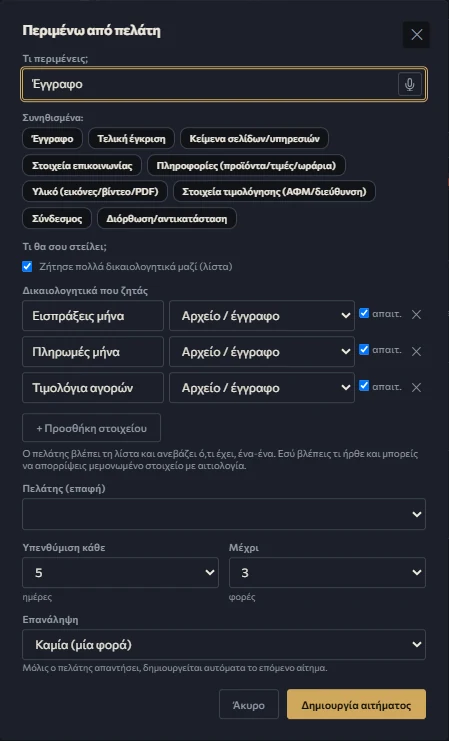
On Eleni’s “VAT return” task, the firm selects “Waiting on client” and lists what it needs: the month’s receipts, the month’s payments, the purchase invoices. It chooses how often Ekkremés will remind her and up to how many times, and whether the request repeats every month.
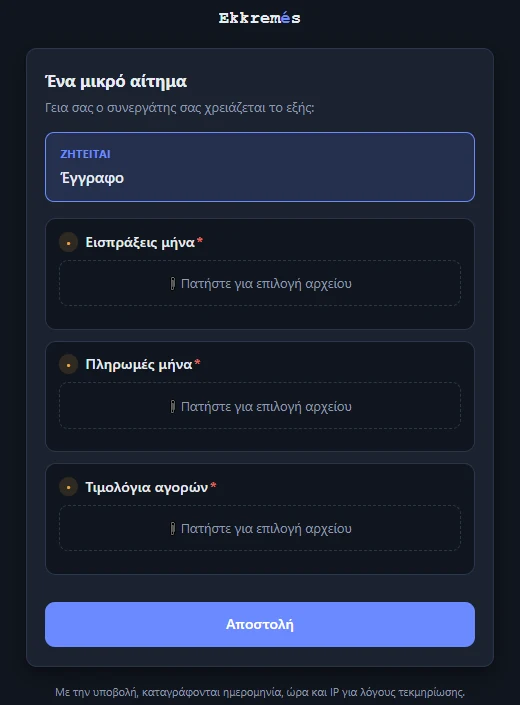
Eleni receives an email with a secure link. She needs no account and no app: she opens the link on her phone and sees a page with three boxes, one for each document. She uploads what she has, one by one, and knows what is still missing.
If she does not, the next reminder goes out on its own, politely, without anyone picking up the phone. As soon as she uploads the files, the task returns to the firm’s list with the documents already inside it, under the right client and the right month. If a document is not what is needed, for example a photo cut in half, the firm rejects just that one, writing the reason, and the client resends just that one.
So on the 20th of the month, the firm does not count from scratch who is missing. It sees it: who it is still waiting on and for which documents, when the request was sent, how many reminders have gone out. The phone is kept for the two or three clients who really need it.
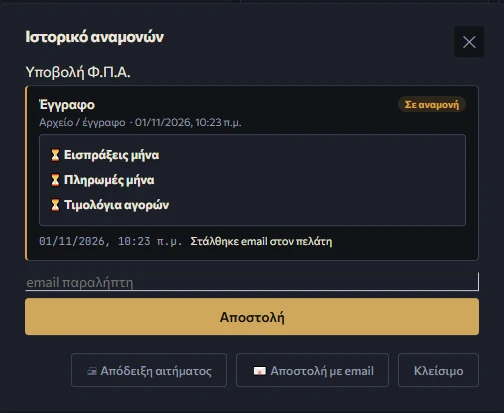
And if someone says “you never asked me for anything”, every request keeps an unalterable history: when it was sent, when the client opened it, how many reminders followed, and when they replied, with date, time and IP. The “request receipt” can be printed if needed.
The documents requested every month are not set up from scratch every month. When the request is recurring, the next one is created automatically as soon as the client replies. And the ready-made packs for accountants create the obligations with their deadlines, so the list does not start from a blank page.
What does not change
A client who does not want to send will not send because an email arrived. But it changes who carries the weight. The firm no longer spends hours reminding everyone. It spends them only on those who really need a human conversation.
Where to start
The whole firm does not need to change at once. Most clients send on time. The problem is usually five to ten specific clients, the same ones every month.
Ekkremés starts free, with no card, with tasks, recurring work and the packs for accountants. The Doorkeeper is in Pro. Try it with the clients who are always late, and compare next month with the last.
See how the firm’s work is organised in Ekkremés. If you would like us to look at it with your own client list, tell us through the form how many clients you have and how you ask them for documents today.
The people in this article are made up. Anyone who has worked in an accounting firm will recognise the situations.
